

In this domestic and global context, calibrated depreciation will help rebalance external fundamentals, offset some of the tariff differentials with competitors, improve the competitiveness of domestic substitutes vis-à-vis Chinese imports, points out Sajjid Z Chinoy.

Last week's depreciation of the rupee vis-a-vis the dollar has raised some anxiety in markets. It should not.
From an economic perspective, it's very important not to conflate a strong currency with a strong economy.
Instead, measured rupee depreciation is both inevitable, and desirable, in the current macro environment.
This piece offers four reasons why:
1. Responding to fundamentals
Exchange rates are typically meant to be an economy's "shock absorber" to external pressures or changing economic fundamentals so that other variables in the economy don't have to undergo disruptive changes.
If movements in the exchange rate can help equilibrate "external balances", monetary and fiscal policy is freed up to focus on trying to achieve "internal balance".
The dynamics of the balance of payments in India over the past one year have become less favourable.
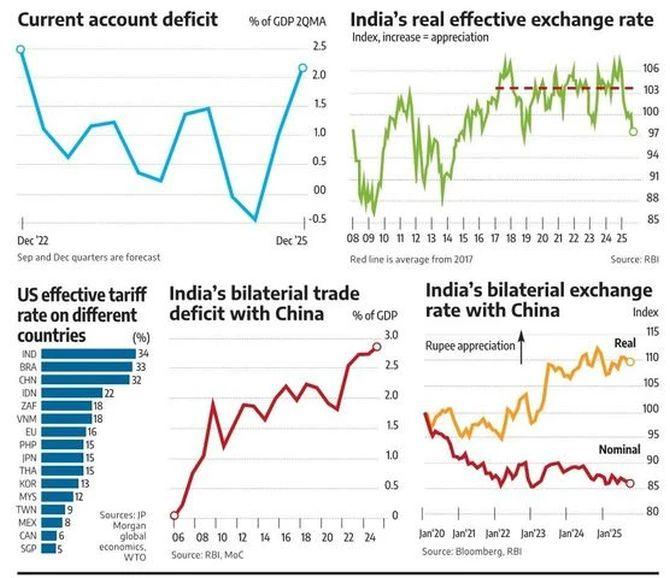
The current account deficit (CAD) is expected to double from $23 billion (0.6 per cent of gross domestic product, or GDP) in FY25 to about $55 billion (1.3 per cent of GDP) in FY26, reflecting declining terms of trade (higher gold prices and the risk of tariffs impacting exports).
To be sure, a CAD of 1.3 per cent of GDP is very sustainable but it has also been accompanied by a discernible slowing of foreign direct investment and portfolio inflows in recent years.
Both these forces (a widening CAD and slowing capital inflows) have put pressure on the balance of payments and the rupee in recent months.
These changing fundamentals would argue for a new -- weaker -- equilibrium for the rupee.
The role of policy is to enable the rupee to move to this new equilibrium in a measured and non-disruptive manner.
As much research has found, a weaker rupee should help boost exports and disincentivise imports and thereby keep the CAD at sustainable levels.
2. Helping offset tariff-induced competitiveness pressures
It is undoubtedly true that some of this transition has already taken place. The trade-weighted real effective exchange rate has weakened by almost 10 per cent over the last year from its highs in November last year.
Furthermore, it is also almost 6 per cent below the average of the last eight years. Yet, the current context matters.
Tariffs imposed by the United States (US) on India are 34 per cent, the highest globally.
In contrast, the effective tariff on the economies of the Southeast Asian nations, which are some of India's biggest competitors in the US market, are 16 per cent, creating concerns that India will be at a competitive disadvantage the longer this differential persists.
Yes, exporters for now have been able to offset US tariffs by redirecting exports to other markets.
But can this sustain?
More calibrated rupee depreciation will, therefore, only help in (at least partially) offsetting these competitiveness concerns.
The longer the wait for a trade deal, the greater should be the onus on the rupee to serve as a partial offset to competitiveness pressures.
3. Increasing domestic competitiveness vis-a-vis Chinese imports
China is beset with a large excess capacity. After the US increased tariffs on China, the latter has increasingly been redirecting its exports to the rest of the world.
Already, India's imports from China and Hong Kong have been rising in a secular manner such that India's bilateral trade deficit with China/Hong Kong has almost doubled from $58 billion before the pandemic to $114 billion in 2024-25.
Some of this represents intermediate imports that are used in the growing exports of smartphones from India.
But, even adjusting for this, imports from China continue to grow, and the risk is this process will accelerate as China increasingly redirects exports away from the US to other parts of the world.
Emerging markets must brace themselves for a China Shock 2.0, except they will be at the receiving end this time.
In India's case, one of the likely reasons that the domestic capex cycle has not taken off is that its manufacturers have to compete with a flood of cheap Chinese imports.
On its part, the rupee in nominal terms depreciated by more 15 per cent against the Chinese yuan since the pandemic.
Yet because of Chinese deflation, the real exchange rate against China has appreciated by 10 per cent during that time, making Chinese imports commensurately cheaper in real terms.
Letting the currency depreciate vis-a-vis the yuan will make Chinese imports more expensive and domestic substitutes more competitive.
Furthermore, this is preferable to putting a tariff on Chinese imports because the latter discriminates against exports while the exchange rate is neutral to both importers and exporters.
4. Contributing to an easing of financial conditions when inflation is benign
One of the concerns of letting the rupee depreciate is the impact on domestic inflation. The Reserve Bank of India estimates that every 5 per cent depreciation vis-a-vis the dollar boosts the retail inflation rate by 35 basis points.
But given how benign the inflation outlook is (FY26 forecast at 2.1 per cent), some depreciation is unlikely to push prices to uncomfortable levels.
Instead, some depreciation should be thought of as an external easing of monetary conditions to complement domestic easing (rate cuts and liquidity).
Finally, because external debt is low, forex depreciation is unlikely to create any meaningful repayment or balance sheet pressures.
In summary
For all these reasons, it's important not to resist rupee depreciation.
In this domestic and global context, calibrated depreciation will help rebalance external fundamentals, offset some of the tariff differentials with competitors, improve the competitiveness of domestic substitutes vis-a-vis Chinese imports, and contribute to the easing of financial conditions at a time when the inflation rate is unusually low.
Markets should not miss the forest for trees.
Sajjid Z Chinoy is head of Asia Economics at JP Morgan
Feature Presentation: Aslam Hunani/Rediff








 © 2026