

Brave statements such as we will continue to be the fastest growing large country are of no consolation, because the direction of trade also determines the flow of investment, points out M Govinda Rao.

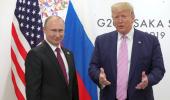
Never in recent history have we come across instances where tariffs are used blatantly as a weapon of subjugation and a threat to national sovereignty in calibrating domestic policies, as United States President Donald Trump has done to establish his hegemony.
While applying sanctions to target unfriendly regimes has become a practice, the use of tariffs as a strategic weapon at this scale is alarming.
Mr Trump has used his dictates on tariff rates not just as a protectionist measure but also as a strategic weapon to determine from whom countries should trade and transact.
Increasing tariffs universally leads to an increase in the prices of imported goods in the US, but that is not our concern.
The uncertainty in international trade and relations has dampened investors' appetite, with adverse consequences on world trade, investment, and economic growth.
An even more serious issue is that individual countries no longer have the sovereign power to calibrate their own economic or diplomatic policies and must go by what the emperor dictates.
For India, the 50 per cent tariff unleashed by Mr Trump is bound to dampen its exports of textiles, leather & footwear, gems & jewellery, chemicals, and electrical machinery.
This will have adverse consequences not only on the current year's growth, employment, trade balance, and macroeconomic stability, but also on the flow of investment in the medium- to long term, disrupting the goal of becoming a developed country.
Brave statements such as we will continue to be the fastest growing large country are of no consolation, because the direction of trade also determines the flow of investment.
As India attracts virtually zero net foreign direct investment and domestic private investment is stagnant, capital flight due to the tariff can have long-term impacts.
The hope of attracting investment under the China-1 strategy will no longer hold.
We can take a defiant view that we are a sovereign country, and that no one can dictate terms to us, but the ability to counter a superpower depends on our own inner strength.
Indeed, countries like China can and do stand up to seek a better bargain.
Despite all the bravado and statements about our own greatness, we should realise that we have very limited bargaining power in the international arena.
Although India's exports to the US in 2024 were valued at $86.5 billion, we enjoyed a trade surplus with the US of $45.7 billion, and that would be significantly impacted.
The US believes that India protects itself highly by not providing access to US exports and, therefore, decided to levy a 25 per cent general tariff rate from August 7.
An additional 25 per cent will be charged from August 27 as a penalty for buying Russian oil and ostensibly financing its war with Ukraine.
India's refusal to give credit to President Trump for stopping the war with Pakistan is also believed to have precipitated this action.
Given India's low bargaining power and the need to accelerate growth, how should it react to this development?
Surely not by increasing protectionism in the name of 'Atmanirbhar' Bharat.
India must further calibrate the opening up of its economy and actively expedite bilateral agreements, in addition to pursuing reforms to achieve greater competitiveness.
Exports have been a powerful engine in every country that has achieved high growth performance.
This is evident even in India after liberalisation in 1991, when its share in global exports increased from 0.5 per cent in 1990 to 2.5 per cent in 2022.
Despite our experience that restrictions on international trade are self-defeating, the policy stance since 2017 has turned inward.
The steadily increasing trend toward protectionism is reflected in the simple average tariff, which rose from 8.9 per cent in 2010-2011 to 11.1 per cent in 2020-2021.
The proportion of tariff lines above 15 per cent increased from 11.9 per cent in 2010-2011 to 25.4 per cent in 2020-2021.
The average most-favoured nation applied tariff on non-agricultural products rose from 10 per cent in 2015 to 15 per cent in 2021.
Liberalising the economy for trade and investment is the only way to accelerate growth.
The advantage of attracting larger foreign direct investment is that it brings advanced technology and improves productivity and competitiveness.
In the name of 'Atmanirbhar' Bharat, we have slowly turned to import substitution, with export incentives to selected sectors.
The time is ripe to erect a proper wall rather than clinging to scaffolding.
The production-linked incentive scheme has had only limited success and needs a careful review.
The objective should not be merely to assemble imported parts but to substantially add value through production, technology, and innovation.
A major sticking point in bilateral trade negotiations is the hesitancy to open up agriculture and dairying.
Excessive protectionism in agriculture and animal husbandry remains a barrier in every bilateral trade negotiation.
It is naive to think that liberalising trade in these sectors would open the floodgates to imports of farm and dairy products.
Over the years, policies encouraging excessive application of fertiliser and pesticides, a consumer- rather than producer-oriented approach in pricing and trade policies, the free supply of irrigated water and electricity leading to increased soil salinity, disincentives for crop diversification, and the drying of aquifers have caused stagnation in production and ecological damage.
The only way to improve productivity in agriculture is to usher in a second Green Revolution, which is possible when we overcome our hesitancy towards GM crops, embrace innovation, use better seeds, and apply fertilisers in a balanced manner.
The cultural and religious concerns may be overblown. Many Indians who travel abroad appear to show little concern about consuming food made from GM crops or drinking milk from cattle fed with animal protein.
The share of the agricultural sector in the country's gross value added is just about 14 per cent. This is the time to move beyond a 'live for the moment' approach, because we need a better tomorrow.
Political obstacles to change are, of course, formidable, but this is an opportunity to cast the net wide, negotiate, seek the cooperation of the states, and work out a time-bound action plan that can also be used in trade negotiations.
The only way to improve farmers' fortunes is to increase their productivity, not to condemn them to penury in the name of protection.
M Govinda Rao is chairman, Karnataka Regional Imbalances Redressal Committee. He was a member of the Fourteenth Finance Commission, and a former director, NIPFP. The views are personal.
Feature Presentation: Aslam Hunani/Rediff







 © 2026