
The outreach comes amid a drop in Indian student enrolments in management programmes at American universities last year, following changes to US student visa policies.

'The US landed in this war without planning. The US felt that if they kill Ayatollah Khamenei the people of Iran will come out on the roads and do a regime change.' 'On the contrary, the US bombings on Iran has united the entire nation.'

Iran has blamed the US for disruptions in oil and gas shipping through the Strait of Hormuz, citing 'destabilising actions' as the cause amid the ongoing West Asia conflict and rising energy prices.

Iranian Foreign Minister Seyed Abbas Araghchi on Saturday criticised the United States over its stance on Russian oil, claiming Washington was now "begging" countries across the globe, including India, to purchase Russian crude.

Rahul Gandhi accuses the government of compromising India's energy security by allowing the US to dictate oil supply relationships, raising concerns about the impact of global conflicts on India's energy access.

According to the Pentagon, the vessels were targeted as part of efforts to prevent the deployment of naval mines in the strategically vital passage through which a significant portion of global crude oil shipments transits.

The incident came shortly after a spokesperson from Iran's military warned that Tehran could target ports and docks in the United Arab Emirates following recent United States strikes on Kharg Island, a key hub for Iran's oil exports.

Israel and the United States had a plan. Iran punched back. And now the Gulf is reeling, the world is beginning to feel the pain and, as on date, no one in Washington or Tel Aviv appears willing to admit that the punch has landed, notes Prem Panicker, continuing his must-read blog on the war in the Middle East.

US Secretary of War Pete Hegseth on Friday claimed that Iran's new supreme leader, Ayatollah Seyyed Mojtaba Hosseini Khamenei, is "wounded and likely disfigured" in strikes by the US on the country.

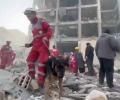
Rescue operations are currently underway, and the circumstances surrounding the incident are under investigation, the command said.

The United States Trade Representative (USTR) office on Wednesday launched a sweeping investigation into manufacturing and industrial practices in 16 economies, including India, citing concerns over what it calls 'structural excess capacity' that could distort global trade. Announcing the move on a White House press call, Jamieson Greer said the probe would be conducted under Section 301 of the Trade Act of 1974, one of Washington, DC's most powerful trade enforcement tools.
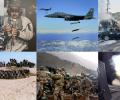
Since 1945, the United States has carried out aerial bombing operations in an alarming number of countries.

The Trump administration has announced a temporary authorisation for countries to purchase Russian oil stranded at sea, aiming to stabilise global energy markets amid rising oil prices and tensions with Iran.

The US torpedo attack on the Iranian warship IRIS Dena in international waters was a lawful act of war between belligerents, not a diplomatic or strategic embarrassment for India, asserts Vice Admiral Biswajit Dasgupta (retd).

Iran's state media cited the spokesperson for the Central Headquarters of Iran's military to claim that a United States military refuelling plane was shot down by a missile fired by resistance groups in western Iraq. The spokesperson further told Press TV that all six service members on board had been killed.

The IRGC said five missiles were launched at 'the headquarters of the US Army at the Harir Air Base in Erbil, located in Iraq's Kurdistan Region'.
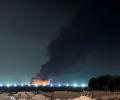
The IRGC said the barrage targeted several US military facilities in the region, including bases at Sheikh Isa in Bahrain, Juffair in Bahrain, Ali al-Salem in Kuwait and Al Azraq in Jordan.

White House Press Secretary Karoline Leavitt on Tuesday said that the United States has not ruled out the option of sending troops on the ground in Iran and that military operations in the Persian Gulf nation would end once the objectives of Operation Epic Fury are achieved.

Amid escalating tensions, Iranian Deputy Foreign Minister Saeed Khatibzadeh declares Iran's unwavering commitment to a 'heroic nationalist defence' against perceived American and Israeli aggression, vowing to resist what he calls an 'invasion' to the very end.

An Indian crew member was killed after a US-owned oil tanker was attacked near Basra, Iraq. Fifteen other Indian crew members were evacuated.

Piyush Goyal on Friday rejected reports suggesting that India is planning to hold off trade deal with the United States for several months.
Iranian President Masoud Pezeshkian maintained a stance of defensive necessity, noting that Tehran is "forced to retaliate to attacks" but clarified that this does not imply a dispute with neighbouring countries

'India should understand that we are not going to make the same mistakes with India that we made with China 20 years ago.'

Russia has shared intelligence with Iran that could help Tehran target American warships, aircraft and other military assets in the region, according to United States intelligence assessments cited by media reports, marking the first indication of Moscow's possible involvement in the ongoing conflict. Officials familiar with US intelligence findings said a significant portion of the shared information reportedly includes imagery from Russia's network of surveillance satellites.

According to the report, the Pentagon is deploying the USS Tripoli ARG, along with the 31st Marine Expeditionary Unit (MEU), part of its own strike group.

'The entire US ecosystem built over decades at the bases in the Gulf region, especially the UAE, costing trillions of dollars have been decimated, dealing a mortal blow to the US Central Command's war capability,' points out Ambassador M K Bhadrakumar.

Top government sources in India have dismissed claims that the Indian Navy provided intelligence to the US regarding an Iranian frigate that was sunk by a US submarine.

Eleven Indian nationals residing illegally in the US have been charged with visa fraud for allegedly conspiring to stage armed robberies of convenience stores to fraudulently claim victim status on immigration applications.

An Indian national has reportedly been killed in an attack carried out by Iran using a 'suicide' boat against a US-owned oil tanker near Iraq. The incident has raised concerns about the safety of seafarers in the region.

The United States has encouraged India to purchase Russian oil already at sea to mitigate supply shortages and price increases amid the West Asia conflict, according to Energy Secretary Chris Wright. This move is described as a short-term effort to stabilise the market without altering Washington's policy towards Russia.

Earlier, another state media outlet showed a display of part of the IRGC's drone arsenal inside a large tunnel. Coinciding with the release of these visuals, the IRGC confirmed the launch of the 48th phase of its retaliatory campaign.

A United States missile strike has reportedly hit an educational facility in Khomeyn in central Iran, according to a report by Al Jazeera citing Iran's Mehr news agency. The site was identified as the Dr Hafez Khomeyni School.

Satellite imagery and expert analysis suggest that a deadly explosion at a school in southern Iran last week was likely caused by a United States airstrike that also targeted a nearby compound linked to the Islamic Revolutionary Guard Corps (IRGC), according to media reports.

The United States has ordered the withdrawal of non-emergency staff from its consulates in Karachi and Lahore, Pakistan, citing security concerns amid regional tensions and protests.

'Engaged in very fruitful discussions to expand our trade and economic partnership.'
Despite the escalation in US military action, the War Secretary noted that Iran's missile response has declined in the last 24 hours.

The US Embassy acknowledged the attack in a post on X, urging Americans to avoid the facility 'until further notice' and announcing that all appointments had been cancelled.

The United States is facing growing discontent from its Gulf allies after several countries in the region complained that they were not given advance notice of the US-Israel strike on Iran that triggered widespread retaliatory attacks, according to media reports.

India has firmly denied allegations that the US Navy is using its ports to launch attacks against Iran, reaffirming its commitment to strategic autonomy and non-alignment in international conflicts.
US Energy Secretary Chris Wright said that long-term oil supplies are 'abundant' and there are no worries regarding that, but in the short term, there is a need to get oil on the market.
 © 2026 Rediff.com - Investor Information - Advertise with us - Disclaimer - Privacy Policy - Sitemap - Feedback - About us - Terms of use - Grievances